SFTP Connections
The SFTP Connections window allows you to configure and manage the SFTP connections used in the available SFTP actions.
SFTP connections support the SSH.NET library version 2024.1.0.
Note: Only users with Owner and Contributor roles can manage SFTP connections.
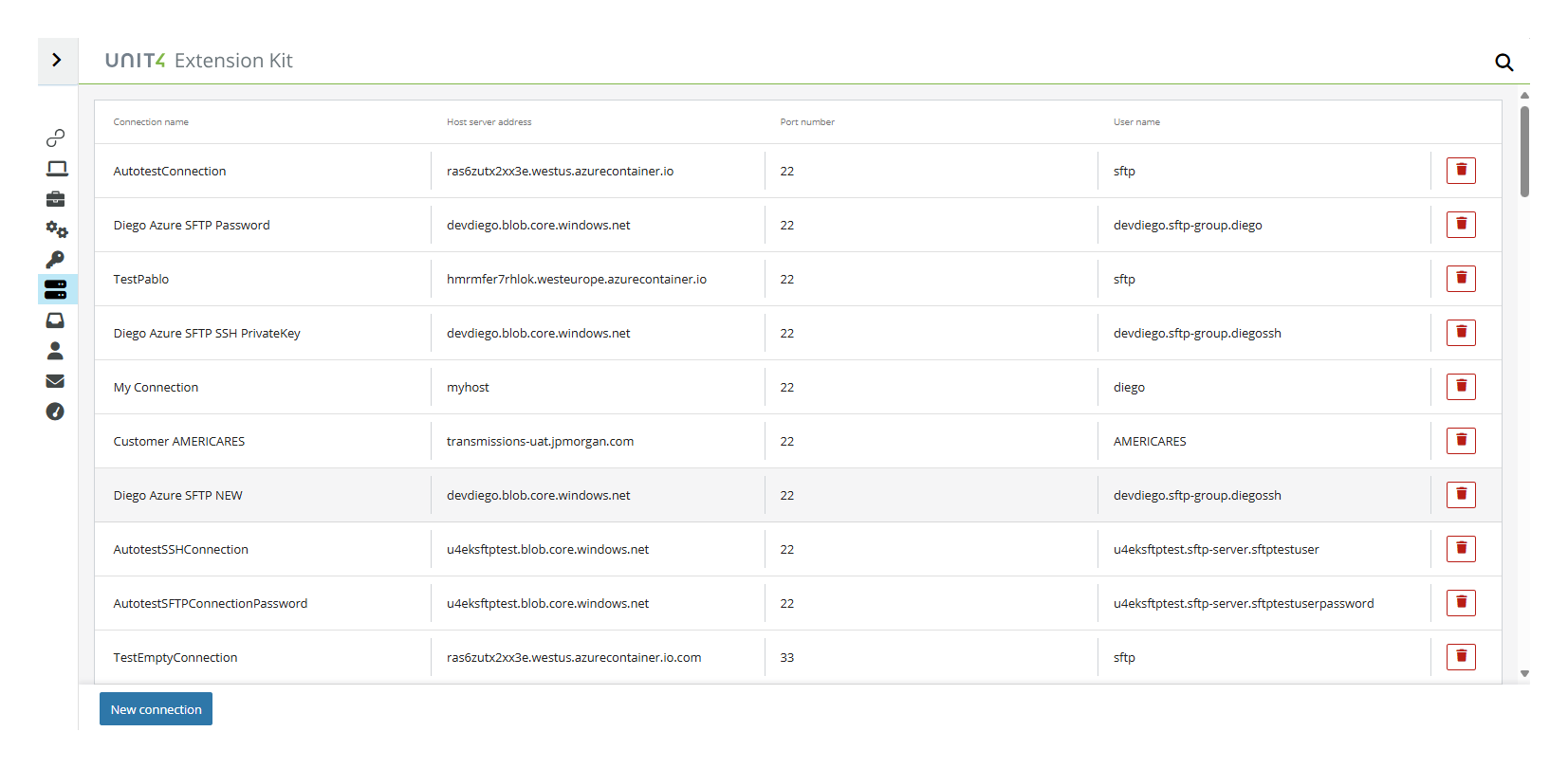
The window shows the:
- Main toolbar – Basic search
- SFTP connections list
- Bottom toolbar – New connection button
1. Main toolbar
Basic search filter
Click on the Basic search button to search the SFTP connection by Connection name.
2. SFTP connections list
It shows the SFTP connections that are currently added to the tenant. It displays the following data:
| Column | Description |
|---|---|
| Connection name | A user-defined label for the SFTP connection. |
| Host server address | The host name of the SFTP server. |
| Port number | The network port used for the SFTP connection. |
| User name | The username for authenticating to the SFTP server. |
| Delete connection | The button to delete the SFTP connection. After clicking it, a dialog appears to ask for confirmation. |
Note: All values must be entered manually by the user when creating a new SFTP connection.
3. Bottom toolbar
New connection button
To add a new SFTP connection:
- Click on the New connection button.
- Enter the SFTP connection details:
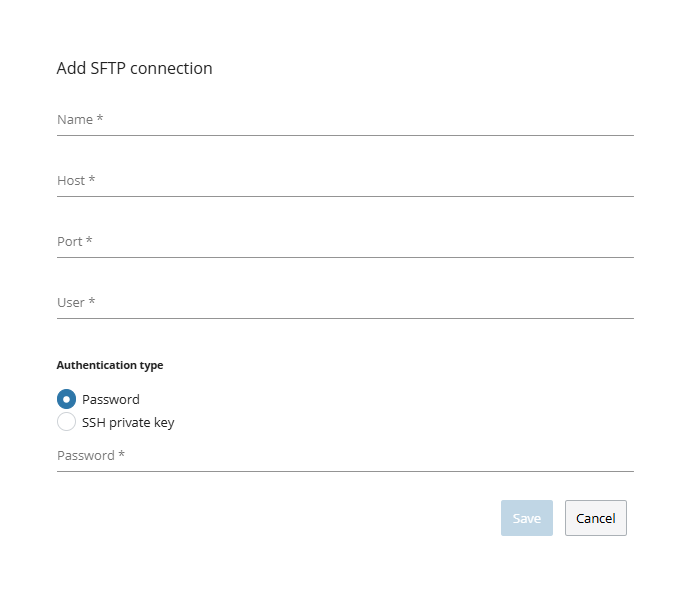
| Field | Description |
| Name | Enter a descriptive name for your connection. |
| Host | Enter the host name of the SFTP server. It is provided by the server administrator or the relevant documentation. |
| Port | Enter the network port used for the SFTP connection. The default SFTP port is 22, but it might vary depending on the server configuration. |
| User | Enter the username for authenticating to the SFTP server. This is assigned by the server administrator and must be known in advance. |
| Authentication type | Select the desired radio button. See the Authentication type fields table below for the fields for each option. |
Authentication type fields
Depending on the selected Authentication type, a different set of fields is displayed.
| Authentication type | Field | Description |
| Password | Password | Enter the password associated to the User. |
| SSH hostkey fingerprint | Enter the MD5 fingerprint of the server host key to verify its identity. See SSH hostkey fingerprint below. | |
| SSH private key | SSH private key | Enter the full contents of the private key file. |
| SSH private key passphrase | For added security, enter the key passphrase if the matching key requires one. | |
| SSH hostkey fingerprint | Enter the MD5 fingerprint of the server host key to verify its identity. See SSH hostkey fingerprint below. | |
| Dual | Password | Enter the password associated to the User. |
| SSH hostkey fingerprint | Enter the MD5 fingerprint of the server host key to verify its identity. See SSH hostkey fingerprint below. | |
| SSH private key passphrase | For added security, enter the key passphrase if the matching key requires one. |
SSH hostkey fingerprint
The SSH hostkey fingerprint field is optional. If it is left empty, the server's host key is not verified and the connection is accepted regardless of the server identity. Therefore, providing the fingerprint is strongly recommended.
If populated, the SSH hostkey fingerprint field must contain the MD5 fingerprint of the server's host key, formatted as hexadecimal pairs separated by colons (lowercase or uppercase are both accepted), for example:
f7:f9:70:c2:3a:65:8c:ed:93:f1:f8:31:c4:34:34:e2
Do not include an algorithm prefix (such as MD5:) or any other text – only the colon-separated hexadecimal value is accepted.
A convenient way to obtain the MD5 fingerprint is to run the following command, replacing <host> with the SFTP server host name and <port> with the SFTP server port (usually 22):
ssh-keyscan -p <port> <host> | ssh-keygen -E md5 -lf -
Note: Omitting the
-E md5option returns a SHA256 fingerprint instead, which is not accepted by the SFTP connection settings.
If the SFTP server exposes multiple host key algorithms (for example RSA and ECDSA), make sure the fingerprint you enter matches the ECDSA algorithm actually negotiated by the connection.
If the configured fingerprint is incorrect, or no longer matches the server's current host key (for example after the server provider rotates its host keys), any SFTP action using that connection fails with an error similar to:
Impossible to establish a connection with server: Key exchange negotiation failed.
Should this happen, re-run the command above to retrieve the current MD5 fingerprint and update the SSH hostkey fingerprint value in the SFTP connection settings accordingly.
SSH private key authentication
Only OpenSSH formatted keys are allowed. Also make sure that the private key is properly formatted. Missing characters and/or incorrect formatting will result in an error.
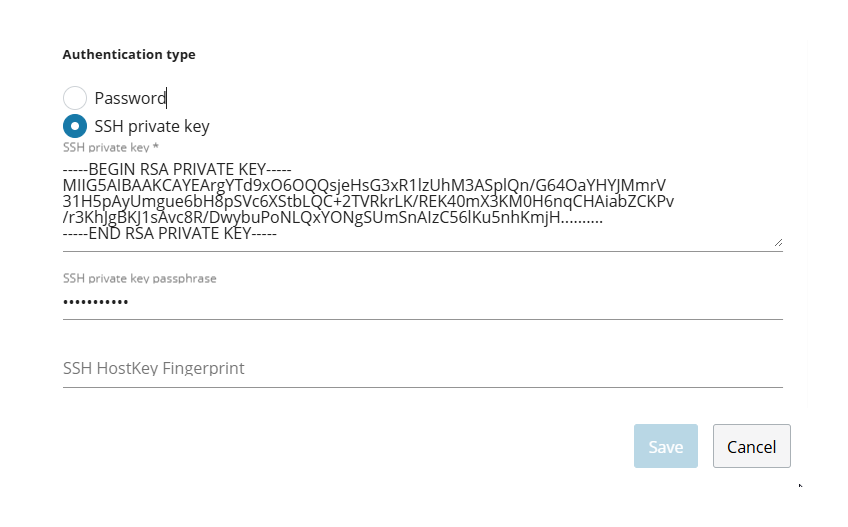
Note: The length of the SSH private key data has been reduced to simplify this example.